Breaking rock
How an asteroid comes apart under your laser, and how much ore it gives.
- Ore
- Up to 6 units a metre
- Weak region
- 1.25 times the work
- Broken rock
- Gone for good
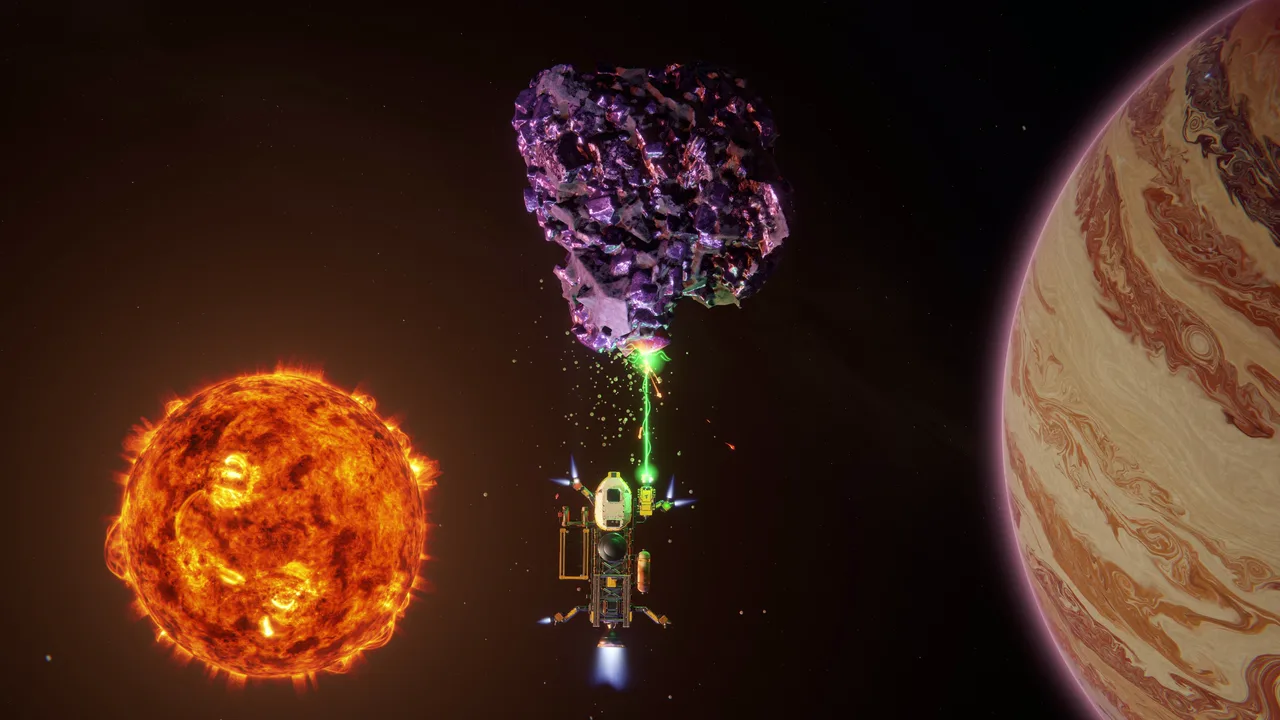
An asteroid is not one solid lump. It is built of sections, and each section of pieces. Your laser breaks it apart along the joints, one section at a time, until the pieces are small enough to carry.
Cracks and breaks
Hold the beam on one spot. Cracks spread out from it while the beam works, glowing on stone and showing as white lines on ice. A ring fills round the crosshair as the work adds up towards the next break. When it closes, the section you were cutting comes away and the ring starts again.
A section that has come away is a smaller body, and quicker to break than the rock it left. A single piece on its own crumbles into debris and ore. Cracks you leave stay where they are; come back and carry on.
Reading the crosshair
Point at a rock. The tag beside the crosshair gives its ore and size, its value signal, what a unit of the ore sells for at Drift, and what the whole rock can give at most. The crosshair’s colour says how long your laser needs for a break: green for a few seconds, through yellow and orange to red for a minute or more. A red cross means it cannot cut this rock at all.
Size
Each laser has a rated size. Up to it the beam works at full effect; above it the effect falls with the square of the excess, so a rock twice the rated size takes four times as long and three times the size nine times as long.
| Laser | Rated size, Level 1 | Level 10 |
|---|---|---|
| Scrappy Mining Laser | 7.8 m | 14.8 m |
| Light Mining Laser | 12.9 m | 24.5 m |
| Prospector Laser | 17.4 m | 33 m |
| Medium Mining Laser | 23.4 m | 44.5 m |
| Heavy Mining Laser | 41.7 m | 79.2 m |
Size means the body under the beam: a whole rock, or a section that has come away. A big rock gets easier as it comes apart.
Value
The richer the rock, the harder it is, and every laser has a class.
| Rock | Scrappy | Light, Prospector | Medium | Heavy |
|---|---|---|---|---|
| Ordinary | Full | Full | Full | Full |
| Valuable | Slow | Full | Full | Full |
| High value | None | Slow | Full | Full |
| Exceptional | None | None | Slow | Full |
Ordinary rock breaks with half the work valuable rock takes; high-value rock takes twice as much, exceptional rock three times. Slow is a third of the laser’s work at Level 1, rising to three quarters at Level 10. A level never moves a laser up a class.
The Alien Resonance Laser cuts like a Medium laser, and at full speed with more than three times its usual work on alien-fused rock and resonant crystal.
Weak regions
Every rock has a few sections less bonded to the rest than the others: two on a rock up to 20 m, three up to 60 m, four beyond. Work that lands on one counts 1.25 times, so it comes away with 80% of the work. A section of 10 m or more that has broken off has a weak piece of its own.
This is true whether you know where they are or not. A Survey Scanner shows you: point at a rock and press Analyze (the Scan key, R). A pulse runs out, a cyan grid covers the rock, and the weak region stays marked in amber. Analyzing the same rock again replays it at no cost.
How much ore
Ore comes out where the rock’s ore runs. Breaks through the deposits you can see on its surface release more of it.
A rock gives at most 6 units of ore for every metre of its size: a 5 m rock 30 units, a 10 m rock 60, a 40 m rock 240. After that, each further break and each crumbled piece leaves only one small unit. Gems don’t count against it. Rare pure bodies follow their own rule.
Small ore rocks
The field just outside Drift station holds small rocks under 3 m across that give iron ore, carbon, construction minerals, iron-bearing basalt or water ice. A Scrappy laser breaks one completely in a second or two, and it leaves one piece of its ore: the easiest first haul there is.
Pebbles and rubble
Tiny pieces drift round every rock in the belt. They bump the ship without harm, and the beam crumbles them; they hold nothing. Loose rubble in the station’s approaches crumbles to one unit of construction minerals.
Rock against rock
A rock driven into another can break both, but only if you set it going: one your ship has rammed in the last ten seconds, or one moved by your Gravity Collapse Charge. Any other knock between rocks is a bump. Breaks from a collision are cold: no glow, no molten spatter.
The Asteroid Penetrator opens a rock from the inside.
What you break stays broken
The belt remembers. A rock you have broken is gone for good once you have left it, and a rock you have pushed stays where you left it.