How rocks break
Every asteroid in Driftlode is a real object with seams, sections and ore inside. Here is what happens when a laser meets one.
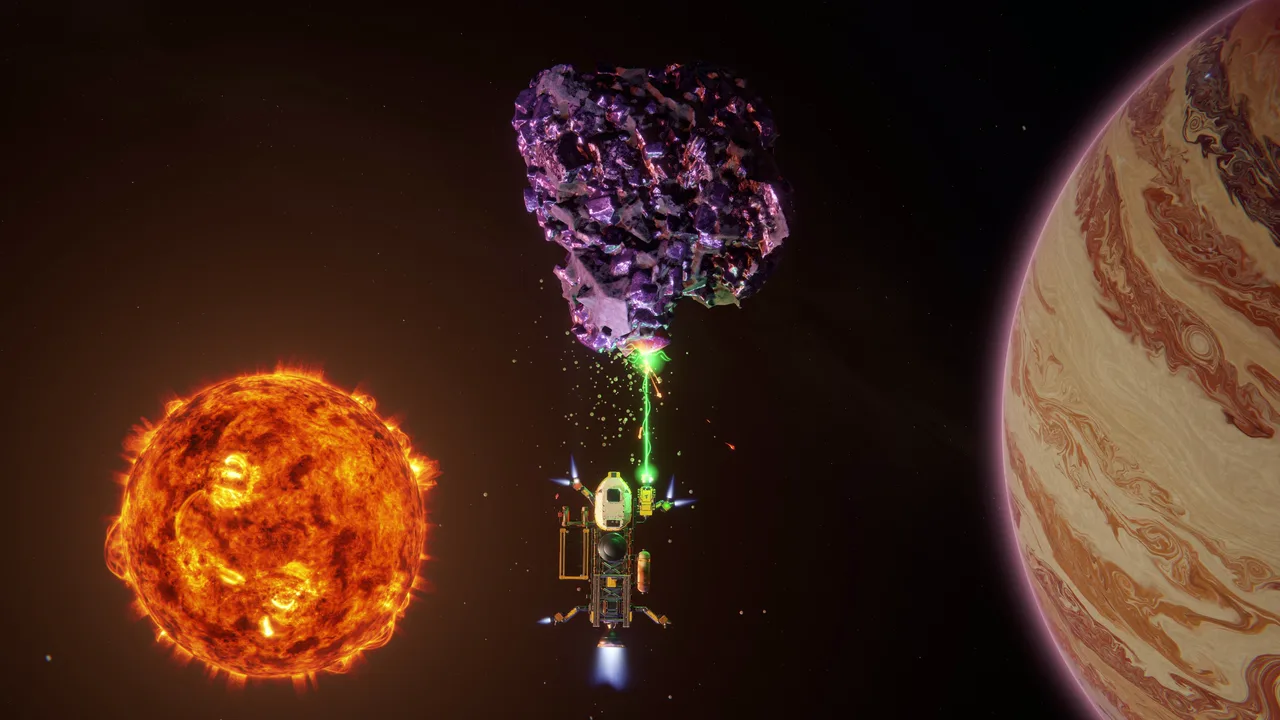
Mining is most of what you do in Driftlode, so the rocks had to be worth breaking. None of them is a health bar with a rock drawn on it.
Built to come apart
Each asteroid is sculpted, then fractured before the game ever runs: first into about eight large sections, then each section into five to eight pieces. The break faces interlock, and every pair of neighbours is joined by a bond with its own strength. A rock is forty to fifty pieces holding hands.
Seams between sections are weaker than the bonds inside one. So a rock opens the way real rock does: big sections come away first, and those break down into pieces you can carry.
What the beam does
The laser weakens the bonds near where it works. Cracks start at the beam and crawl outward along the seams, and they only move while you keep cutting. Every second the beam spends on a rock counts towards its next break, and the section that comes away is the one under the beam.
Size matters as much as time. Every laser has a rock size it is rated for. Past that, its effect falls with the square of how much larger the rock is: twice the size takes four times as long, so the starter laser on a forty-metre rock is a pocket knife on a tree.
The ore is where you see it
The veins drawn on a rock’s surface come from the same field the game reads when a piece breaks free. Cut where the veins run and ore comes out there. Nothing is rolled behind the scenes when the rock dies.
No smoke in space
There is no air out there, so nothing billows. A break throws thousands of grains that fly straight until something stops them, each lit by the sun. Iron spatters molten metal that cools to a crust. Ice sprays meltwater that refreezes. It took a while to make that look right without a single puff of smoke.